
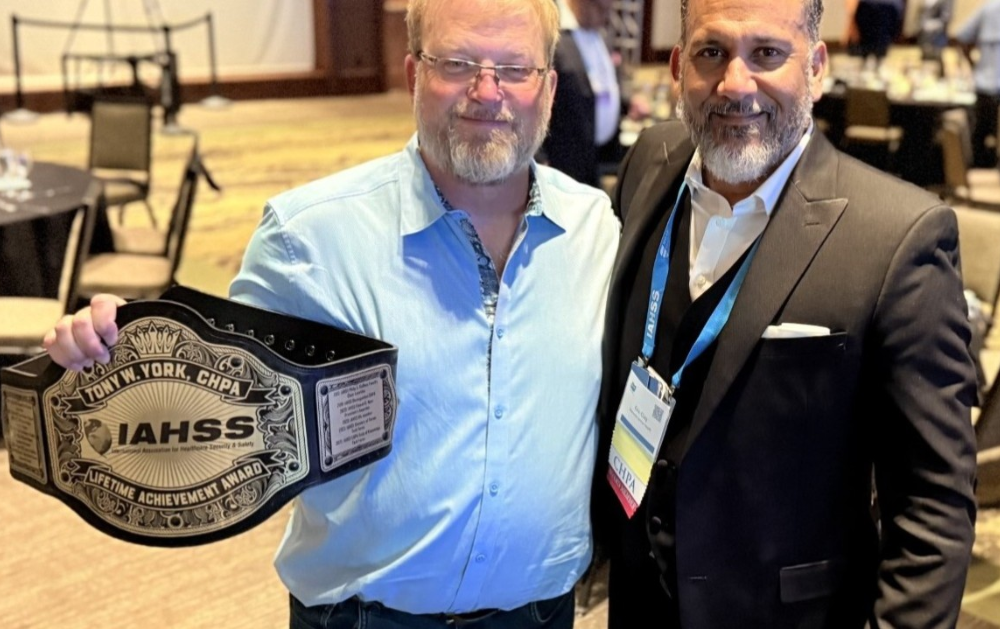
There’s a book on the desk of nearly every serious healthcare security professional. “Hospital and Healthcare Security,” authored by my good friend Tony York, CPP, CHPA, and it is widely regarded as the definitive text on the subject.
But ask Tony York what shaped his career most, and he won’t point to a textbook. He’ll point to people who invested in him, and the people he later invested in.
That distinction matters more than we often acknowledge.
A Profession Built on Passed-Down Knowledge
Healthcare security sits at the intersection of patient care, public safety, behavioral health, and regulatory compliance.
The stakes are uniquely human and unlike those in any other security discipline. A hospital security officer isn’t simply protecting an asset; they may be helping a patient in crisis, supporting a grieving family, or de-escalating a situation no policy could have fully anticipated.
Those are lessons that rarely come from a textbook alone.
To me, mentorship is the invisible infrastructure of the healthcare security profession, the framework that holds everything else up. When the International Association for Healthcare Security and Safety formalized certification pathways and industry guidelines, it wasn’t simply codifying knowledge. It was creating scaffolding that allows mentorship to occur at scale: a shared language, common standards, and a framework that encourages experienced security professionals to invest in the next generation.
Like so many others, I have been a beneficiary of that investment.
Tony York: What a Career Built on Mentorship Looks Like
Tony’s story is worth studying not only for what he has accomplished, but for how he accomplished it, and how he multiplied that impact through others.
Tony began his healthcare security career at North Carolina Baptist before joining Hospital Shared Services of Colorado (HSS) in 1994. Over the next three decades, he rose from a frontline role to one of healthcare security’s most recognized and respected leaders. Along the way, he became one of the youngest professionals to earn ASIS’ Certified Protection Professional (CPP) designation, served as President of IAHSS, and became a longtime contributor to both the IAHSS Healthcare Security Industry Guidelines and Security Design Guidelines for Healthcare Facilities. He also authored three editions of Hospital and Healthcare Security, and received numerous honors, including the Elwood G. Near President’s Award and the Bill Navejar Lifetime Achievement Award.
Yet perhaps the most telling tribute came from Alan Butler, IAHSS Past President and former Senior Vice President at HSS, who presented Tony with the IAHSS President’s award.
Alan didn’t begin by highlighting Tony’s credentials, publications, or many industry accolades. Instead, he led with this: “Tony York has mentored several healthcare security leaders who are now in influential positions across the country.”
In many ways, that’s the resume that matters most.
Titles eventually pass. Publications age. The leaders you help develop become your lasting contribution to the profession.
Tony has been open about his own philosophy: “I enjoy sharing my story of growth in the security industry, especially if it inspires others. I always want to help others feel confident that with hard work, perseverance, and a drive to be a life-long learner, there are many opportunities to grow as security professionals and leaders.”
That philosophy, “give back what was given to you,” is one of the cultural engines of our profession. Alan has credited Tony with encouraging him to pursue volunteer leadership within IAHSS, noting that it was always important to Tony that those around him give back to the profession as well.
In Tony’s world, mentorship isn’t a favor; it’s a professional obligation.
Don MacAlister and the Tradition of Paying It Forward
Tony isn’t alone in embodying this ethos. His co-author and colleague Don MacAlister, CPP, CHPA, who spent over 35 years in security, built one of Canada’s most respected healthcare security programs, and was recognized with the IAHSS Distinguished Lifeworks Medal, one of the rarest honors in the field.
What stands out in the nomination that Tony, Tom Smith, and Kevin Tuohey submitted on Mr. MacAlister’s behalf isn’t simply a list of operational accomplishments. It’s the emphasis on the professionals he mentored, the relationships he built, and the impact he had by helping others succeed.
MacAlister has often been described as the patriarch of hospital security in Canada, a title earned as much through mentorship as through management.
The pattern is consistent among the profession’s most respected leaders: technical excellence earns respect, but mentorship creates legacy.
Bonnie Michelman and the Mentorship Imperative for a Diverse Field
No discussion of mentorship in healthcare security would be complete without acknowledging Bonnie Michelman, CPP, CHPA. As highlighted in the documentary, Women in Security, few individuals have done more to expand the definition of who belongs in this profession.
As the longtime Executive Director of Police, Security and Outside Services at Massachusetts General Hospital, and later Vice President and Chief Security Officer of Mass General Brigham, Bonnie built one of North America’s most decorated healthcare security programs, earning the prestigious Lindberg Bell Award twice. She also served as President of IAHSS and ASIS International.
Yet Bonnie has been equally passionate about something less tangible: mentorship.
She has consistently emphasized the importance of mentorship, particularly for women and underrepresented professionals entering a historically male-dominated field. She understands from personal experience that talent alone does not determine who advances. Access to guidance, sponsorship, and intentional mentorship often makes the difference.
This insight extends beyond individual careers.
Healthcare security will only become as strong and capable as the talent it attracts, develops, and retains. Mentorship should be viewed not only as a leadership responsibility, but as a recruitment and retention strategy.
What IAHSS Gets Right About Institutionalizing Mentorship
IAHSS has understood this reality for decades. The association’s CHPA Prep Mentoring Program provides structured one-on-one relationships between experienced practitioners and emerging professionals. Mentors serve as “a friend, a teacher, and a guide,” helping mentees navigate certification, leadership development, and the broader profession.
This is how knowledge compounds over time.
IAHSS’s broader infrastructure, including certification pathways from Basic Healthcare Security Officer through CHPA, the Council on Guidelines, annual conferences, and resources such as the Security Design Guidelines for Healthcare Facilities, creates the conditions for mentorship to thrive. These programs give experienced professionals something to teach toward and emerging professionals something to aspire to.
Twelve years ago, when I entered healthcare security, leaders such as Bonnie and Tony were role models I looked up to and hoped to emulate.
IAHSS’ publications and educational offerings provided a foundation for learning industry best practices. Professionals such as Bill Marcisz, Paul Sarnese, and many others provided guidance, encouragement, and mentorship. Tony even invited me to co-present before a national audience — an opportunity that accelerated my professional growth and reinforced the importance of paying opportunity forward.
Despite a handful of vocal critics, IAHSS represents what a healthy professional ecosystem should look like: a community where the knowledge and experience of leading practitioners flow to those just beginning their journey.
The Practical Case for Mentorship Right Now
Healthcare security faces a convergence of challenges that make mentorship more important than ever.
Rising workplace violence. Physical assaults against healthcare workers remain a significant and growing concern. New professionals need more than policies and procedures; they need experienced mentors who have managed real-world crises and can share hard-earned knowledge.
Increasing complexity. Behavioral health, patient rights, trauma-informed care, and de-escalation have become core competencies. These skills are often learned most effectively through experience and mentorship rather than coursework alone.
Leadership pipeline gaps. Like many specialized professions, healthcare security is experiencing the retirement of foundational leaders. If their institutional knowledge is not intentionally transferred through mentorship, it risks being lost altogether.
A more diverse profession. Building a workforce that reflects the communities it serves requires intentional sponsorship and mentorship for individuals who may not resemble the profession’s historical majority.
A Call to Action
If you’re a senior leader in healthcare security, ask yourself a simple question: Are you intentionally developing someone?
The next generation of Tony Yorks, Don MacAlisters, and Bonnie Michelmans are already here. They attend monthly chapter meetings, join Special Interest Groups (SIGs), volunteer on committees, study for the CHPA, and look for guidance. Our responsibility is to meet them where they are.
If you’re earlier in your career, seek mentorship with the same intentionality you bring to your education certifications. IAHSS programs are an excellent starting point, but don’t wait for a formal program. Reach out.
Like most experienced professionals in this field, I became experienced because others were willing to invest in me. And each of us remembers those investments.
The security of healthcare facilities is measured in incidents prevented, caregivers protected, and environments made safer. The future of healthcare security, however, is measured in something far less tangible: the next generation of leaders we build together.
For more than three decades, Tony York has helped build that future one person at a time.
That’s a legacy worth celebrating, and one worth emulating.